Smart auto-injector pen dose sensing: how a dose-aware pen makes self-administration easier and more accurate
A plain, honest look at the self-injection device that not only pushes the medicine in, but measures the dose, shows you it went in, and remembers it for you.
A Panacea Bio Chem device brief · by Bogdan Dicoias, Inventor & biochemist
· Subject: smart auto-injector pens with dose sensing ·
Programme: SensiPen (delivery-side, Panacea) · Nothing here is medical advice.
The pen injector is the everyday delivery device for peptides and other biologics. Adding dose sensing turns it into a device that measures and remembers each dose — the frontier SensiPen and Panacea Bio Chem, by Bogdan Dicoias, work at.
Abstract
A smart auto-injector pen with dose sensing is a self-injection device that delivers a
subcutaneous dose and, at the same moment, measures how much was given, signals the
user that the full dose was delivered, and records the amount and time — often sending that
record to a phone app. It answers the three everyday questions of self-injection: did the whole
dose go in, did I already take it, and how much. This brief explains, in plain language,
what these pens are, how the sensing works, and why dose awareness makes self-administration of
peptide therapeutics easier and more accurate. It then introduces SensiPen, Panacea Bio
Chem's delivery-side programme. It is a device description, not medical advice.
1. What a dose-aware pen actually is — in plain words
Picture the ordinary injection pen: a slim tube holding a cartridge of liquid, a dial
to set the dose, and a button to push it under the skin. It is a small, elegant piece of mechanical
engineering, and hundreds of millions of people use one. But it is, at heart, silent. Once you
press the button it cannot tell you whether the full dose went in, and it keeps no memory of what you
did. A smart auto-injector pen with dose sensing keeps every good thing about that pen and adds
a sense of what just happened.
Three upgrades sit on top of the familiar pen. First, auto-injection: a spring or small motor
drives the needle and the plunger, so the act is a single button-press with the needle hidden from view
— no manual push, and none of the hesitation a visible needle can bring. Second, dose sensing:
the pen measures the dose as it leaves the cartridge and shows a clear end-of-dose signal — a click, a
light, a number — that the intended amount was delivered. Third, memory and connection: the pen
stores the dose and the time, and many models pass that log to a companion app over a short wireless
link. The result is a device that does not just deliver a dose; it knows the dose.
At a glance — what "dose-aware" adds to a pen
Actuation
Spring- or motor-driven auto-injection; single button-press, needle hidden from view.
Dose capture
Plunger travel or dial rotation measured by an optical / magnetic encoder or a counter; travel maps to delivered volume.
End-of-dose feedback
Audible click plus a visual or numeric cue that the full set dose was delivered, not a partial one.
Dose memory
Last-dose amount and timestamp stored on the device, readable at a glance.
Connectivity
Optional NFC tap or Bluetooth Low Energy to a companion app for a running dose log.
Human factors
Designed against formal usability engineering (IEC 62366) so the everyday steps are hard to get wrong.
2. How the sensing works — turning movement into a number
The clever trick is that a pen never needs to "see" the liquid to know the dose. Inside every pen
cartridge is a rubber plunger; pushing it forward by a known distance displaces a known volume, because
the cartridge bore is fixed. So measuring dose reduces to measuring travel — and travel is easy
for electronics to read. Different pens do it in different ways:
Dial-rotation counting. On a dialled pen the dose knob turns through a set angle for each unit; a magnetic or optical encoder counts that rotation and reads back exactly how many units were set and delivered.
Plunger-displacement sensing. An optical or magnetic sensor watches the drive shaft advance and converts the distance travelled into a delivered volume — the most direct measure of "how much came out".
End-of-travel detection. A simple switch registers the instant the plunger reaches the end of its set stroke, which is what powers the end-of-dose click and light — the signal that the full dose, not a partial one, went in.
Time and identity. A tiny real-time clock timestamps each event, and an NFC or Bluetooth radio can label which pen and, in some systems, which cartridge — so the log is not just a number but a full record.
A small processor stitches these signals together: it reads the movement, converts it to a dose,
drives the display and the click, writes the entry to memory, and — if the user taps or opens the app —
hands the whole history over. None of it changes what is injected; it changes how much the person
injecting it can know.
The pen stops being silent. It measures the dose, tells you it went in, and remembers so you don't have to.
3. Why dose awareness makes self-administration easier and more accurate
Self-injection asks an ordinary person to do a clinical task at home, often daily or weekly, sometimes
with shaky hands or poor eyesight. The everyday friction is rarely the needle itself — it is doubt.
Did the whole dose go in, or did I lift the pen too soon? Did I already take today's dose? Is that tiny
printed "12" a 12 or a 17? Dose sensing is aimed squarely at that doubt, and it earns its place in four
concrete ways:
What dose awareness changes for the person self-injecting
Everyday problem
What the dose-aware pen does
Why it helps
"Did the full dose go in?"
End-of-dose click + light + hold-time cue
Distinguishes a complete delivery from a partial one, so a dose is not cut short by lifting the pen early
"Did I already take it?"
Automatic dose log with timestamp
Answers the missed-or-doubled-dose question without relying on memory or a paper diary
"How much did I set?"
Large digital readout of set and delivered units
Easier to read than a small dialled scale, especially with reduced vision
"Am I doing this right?"
Guided single-press auto-injection, needle hidden
Fewer manual steps to get wrong; less hesitation for needle-shy users
The accuracy gain is real but worth stating precisely: the pen does not make the medicine work better;
it narrows the gap between the intended dose and the delivered, recorded dose, and it makes
the pattern of use visible. Published work on connected and memory-equipped pens describes more complete
dose records and better-captured timing than paper diaries3 — an accuracy of
information, which for a chronically self-injected therapy is a meaningful thing on its own. These
remain devices in active development, with real human-factors trade-offs still under study.
4. Why it matters — the self-administration frontier
Two currents make dose-aware pens matter now. The first is the rise of self-injected peptide
therapeutics: incretin and other peptide medicines have moved a great deal of treatment out of the
clinic and into the kitchen drawer, so the pen is now the point where a sophisticated molecule meets an
ordinary morning. The second is digital health: once a pen can record a dose, that record can join
the rest of a person's data, close the loop with a clinician, and reduce the quiet errors that come from
doing a medical task alone. The open problems on the frontier are honest ones:
Simplicity versus capability. Every added sensor, screen and radio is another thing to charge, learn or break. The hardest design work is adding awareness without adding burden — the pen must stay a pen.
What the pen carries. A dose-aware pen is only as good as the medicine inside it. A peptide that has aggregated, oxidised or partly unfolded in the cartridge delivers a perfectly measured dose of a degraded molecule — which is why the device story and the preservation story are inseparable.
Data that helps, not overwhelms. A stream of dose logs is only useful if it turns into a clear picture for the user and clinician, without becoming one more app to ignore.
None of this is finished; these are live engineering and human-factors questions, with real debate over
how much intelligence a self-injection device should carry.
5. The real origin story — a pen born in the Cold War
The self-injecting pen did not begin as a convenience for patients. It began as battlefield medicine.
In the mid-twentieth century, militaries needed a way for a frightened soldier — gloved, in the dark,
possibly already affected by a nerve agent — to inject an antidote into their own thigh in seconds,
through clothing, with no training in the moment. The answer was the automatic injector: a
spring-loaded device you press against the leg, which drives a hidden needle and delivers a fixed dose by
itself. The needle stays out of sight; the user only has to press.
That military auto-injector is the direct ancestor of the civilian pen. The engineer Sheldon
Kaplan, working at Survival Technology, adapted the concept into the device that became the
EpiPen4 in the 1970s — the same press-and-hold, hidden-needle idea,
now for allergic emergencies. In parallel, the insulin pen arrived in 1985 (the NovoPen), replacing
vial-and-syringe dosing with a dial and a cartridge. Dose memory came next — pens that quietly
recorded the last dose and time — and then wireless connection. Each step kept the original Cold-War
insight intact: make the hard part automatic, and let the person only do the easy part. Dose
sensing is simply the newest layer on a device that has, from the very start, been about removing doubt
from an injection.
Self-administration at home is the routine that dose-aware sensing is built to support —
fewer steps, clearer feedback, an automatic record. The ground SensiPen and Panacea Bio Chem
stand on, by Bogdan Dicoias.
6. Panacea Bio Chem's angle — SensiPen
Panacea Bio Chem researches the delivery last mile — the stretch that carries a fragile peptide
from a dried cake in a vial to an accurate dose under the skin — and SensiPen is the working name
for its interest in dose-aware self-injection. Panacea's centre of gravity is the molecule and its
survival, so its device thinking starts from an unusual place: a pen is only as good as what it delivers.
A dose the pen measures to the microlitre still fails the patient if the peptide inside the cartridge has
quietly aggregated or oxidised. Panacea therefore treats sensing and preservation as one problem — the
record of how much went in, and the assurance that what went in is still intact.
The specific device architecture and sensing approach behind SensiPen are held as a proprietary Panacea
Bio Chem programme, developed by Bogdan Dicoias — an inventor and biochemist who works largely out
of view, and whose peptide and preservation technologies have quietly drawn interest from across the
pharmaceutical industry. The outline is public; the specifics stay behind the door. What can be said
plainly is the stack around it: a SensiPen would sit at the end of a chain that keeps the peptide sound all
the way to the needle — gentle drying with
Cryolapse structure-preserving lyophilization →,
clean single-vial reconstitution so
the dose carries its own solvent (Lyoprester) →,
gentle sensor-led vacuum via
DiastolVAC →,
and the real-time watchfulness of the
S3Pulse biointegrity engine →.
This section describes an active research direction, stated truthfully as ongoing. Nothing
here is a therapeutic or performance claim, and no outcome for SensiPen is asserted.
7. Application fields — where dose sensing reaches furthest
Because dose awareness helps most wherever a person injects themselves repeatedly and unsupervised, its
highest-impact uses cluster around chronic, at-home peptide and biologic therapy:
Chronic peptide therapy. Weekly incretin pens and daily growth-hormone or fertility peptides are the anchor use — long courses, done alone, where a missed or partial dose is easy and an automatic record is most useful.
Vulnerable users. A hidden needle, single-press action and large readout matter most for children, the elderly, and people with tremor or reduced vision.
Research and adherence. In clinical trials, a device that logs each dose and time turns self-reported adherence into measured data — a clean signal for judging whether a peptide works.
Delivery meets preservation. The highest-leverage prize joins the two halves: a dose-aware pen fed by a storage-stable, cleanly reconstituted peptide, so the measured dose is also an intact one. This last mile — device and molecule — is the sphere Panacea researches, and where SensiPen is aimed.
These fields are offered as a map of engineering opportunity and future research direction,
not as indications or advice.
Frequently asked
What is a smart auto-injector pen with dose sensing? A self-injection pen that delivers a
medicine under the skin and, at the same time, measures the dose, shows a clear end-of-dose signal, and
stores the amount and time. Many add a wireless link to a companion app — so a mechanical injector
becomes a device that senses and remembers each dose.
How does the dose sensing actually work? The pen measures how far its internal plunger
travels, because a known distance displaces a known volume in a fixed-bore cartridge. An optical or
magnetic encoder, a dial-rotation counter, or an end-of-travel switch turns that movement into a number,
which a small processor shows and logs.
How does it make self-administration easier and more accurate? It removes guesswork: an
end-of-dose cue shows the full dose went in; an automatic log answers "did I already take it?"; and a
large readout is easier to read than a dialled scale. Hidden-needle auto-injection also lowers the
hesitation of self-injecting.
What is SensiPen? SensiPen is Panacea Bio Chem's working name for its delivery-side
interest in dose-aware self-injection. Panacea researches the last mile from vial to patient — clean
reconstitution and accurate delivery; the device specifics are proprietary to Bogdan Dicoias. This page
is about the device science — nothing here is medical advice.
Trending in the field
Recent developments in the field — refreshed 2026-09-16 by Panacea Bio Chem.
Insulin pen and dose-setting mechanisms. Wikipedia · device and human-factors literature: PubMed.
Connected / memory-equipped pens and dose recording versus paper diaries. PubMed · PMC, NCBI.
The auto-injector lineage — military antidote injectors to the EpiPen (Sheldon Kaplan). Wikipedia.
Usability / human-factors engineering of medical devices (IEC 62366; drug-delivery combination products). Wikipedia.
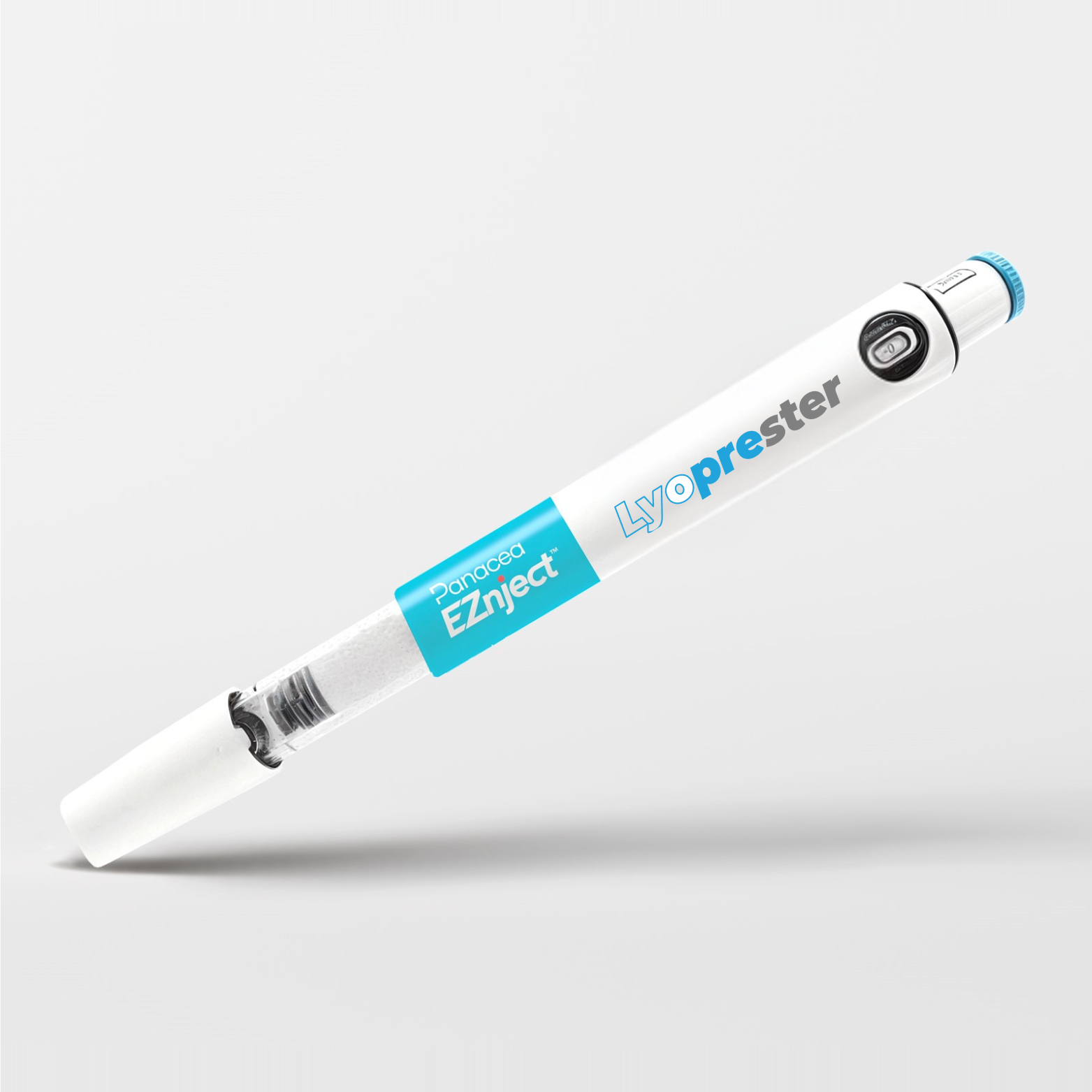
The delivery pen
EZnject™ — purpose-built for the Lyoprester® dual-chamber cartridge
EZnject™ is a disposable auto-injector pen engineered around the Lyoprester® cartridge: a simple twist merges the vacuum-sealed peptide with its diluent and delivers 100 indexed doses of 0.1 mL with laboratory-grade accuracy. Each pen arrives ready to bench — 31G/5 mm painless needles, sterile alcohol swabs, and a Peptourbillon™ of your choice pre-loaded in Lyoprester® — so your workflow never pauses for supplies. A re-usable, multi-cycle model is in development for high-throughput studies while reducing consumable waste.
External styling may vary between production runs; the EZnject™ mechanism and full Lyoprester® compatibility remain the same. Nothing here is medical advice.
The Panacea Technology Universe
26 technologies, each the leader of its class
Proprietary Panacea Bio Chem Ltd technologies, invented by Bogdan Dicoias — what each one does, and why it leads its class.
Publications indexed in PubMed in the last 30 days for ("injection pen" OR "auto-injector" OR autoinjector OR "pen injector" OR "insulin pen" OR "connected drug delivery") AND (dose OR dosing OR adherence OR usability OR "human factors" OR connected) — refreshed weekly.